
Farewell to honorary member Tomaž Tozon
Published February 17, 2025
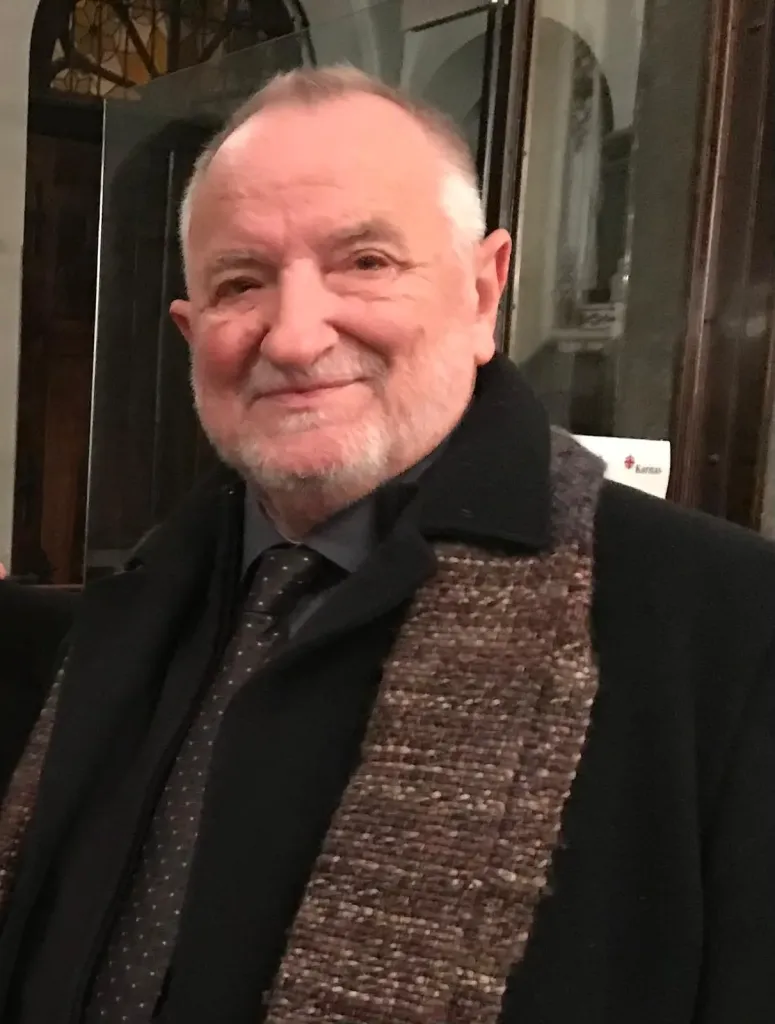
Tomaž Tozon
29. 11. 1937 – 17. 2 2025
With sadness we announce that our friend and honorary member of the Slovenski oktet, the baritone Tomaž Tozon, has passed into eternity.
May he rest in peace!
“Sincere singing is a shortcut to happiness.” Tomaž Tozon
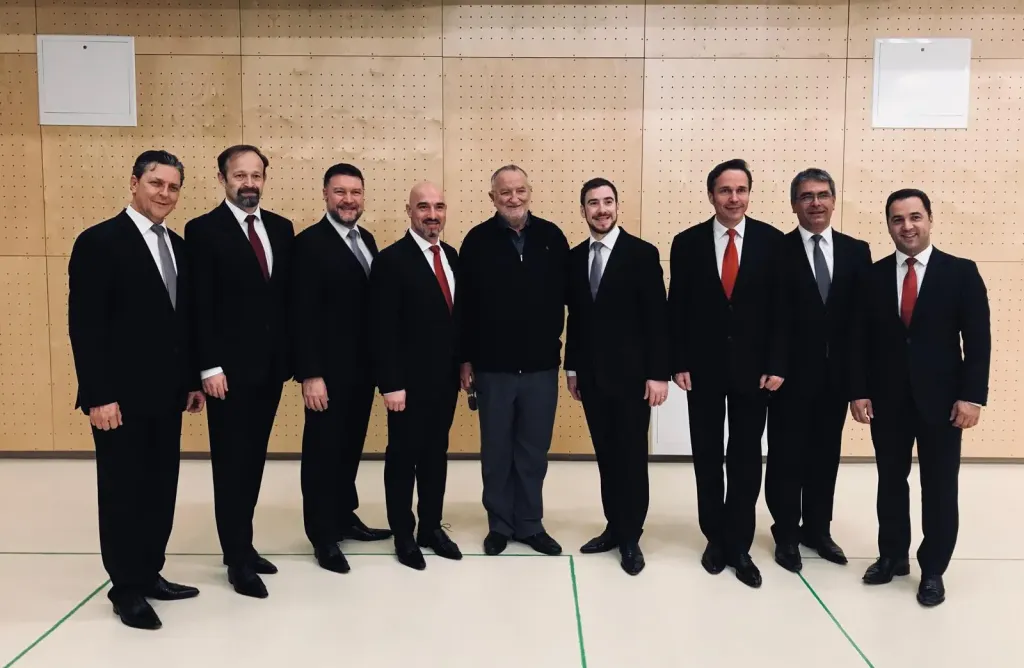
Excerpt from B. Pangerc: Slovenski oktet, Ljubljana, 2007
He was born in Ljubljana on 29 November 1937; he studied musicology at the Academy of Music and by profession was an editor and producer at RTV Slovenija.
He sang with the Academic Choir, the RTV Chamber Choir, the “Emil Adamič” Teachers’ Choir, the Kvartet Do and, of course, the Slovenski oktet. As a child he sang the song “Kaj mi poje ptičica” in the film “Kekec”, thus proving his singing talent early on.
By voice he is a baritone; he sang in the Slovenski oktet from 1978 to 1996.
Singing, says Tozon, is strongly connected with the soul. That is why he liked to sing all kinds of songs, all those that had enough expressive power; songs without artistic charge, without some message, that are too contrived, do not appeal to him and he is not well disposed towards them.
As for the form of concerts, Tomaž Tozon liked stylistic concerts. He is more critical of contemporary music, because he believes it is often hard to experience properly and therefore even harder to interpret.
Of the tours with the Slovenski oktet, he remembers Norway and Spain best. In any case, the kind of life he lived with the Slovenski oktet is geared to the mission of bringing people together through or in the name of song. With the Slovenski oktet he felt at home everywhere.
Of experiences worth recording, Tozon stressed that the strongest was meeting Nicolai Gedda. From the singing side this experience was the most mature and full, also because he was aware of the greatness of the artist with whom he was standing on stage. All the concerts with Gedda drew real ovations from the audience.
“When we were performing on a tour of Spain, Gedda was singing in Madrid. We were driving to the next place on our planned tour and on the way we happened to catch a radio broadcast from Madrid of Nicolai Gedda’s recital. We were particularly enchanted, I would say simply overwhelmed, by the applause Gedda received at the end of the concert, which seemed to have no end. It was indescribable and unforgettable.
I also remember vividly the experience of preparing for larger concerts and the atmosphere after the concert in more renowned halls, such as in Beijing or at the Teatro Colón in Buenos Aires. There, for example, people stood in line from five in the morning to secure a ticket.
It was equally intriguing in places where we performed for an audience about whom we could not know in advance how it would receive our songs. We experienced this, for example, in Africa. It is interesting and surprising that all barriers fell away at once. The folk feeling for folk song is everywhere similar or the same.
A very special memory ties me to Angola. We had a tour announced. We were supposed to sing at the birthday of President Agostinho Neto. But during the tour he suddenly died and all events across the country were cancelled at once, including our concerts. We were put up at the Hotel Tropical; we lived like in a fairy tale, but we were not allowed to move from the hotel – except to sing at the funeral ceremony for the late president. And that at the heartfelt request of his wife.
On the day of the funeral he was brought from Moscow, where he had died, and the members of the Slovenski oktet were asked to sing at the mourning ceremonies. The singers, dressed in tuxedos, marched right behind the coffin along the main street of the city to the presidential palace, where President Neto lay in state, and we sang to him for several hours, all the while that domestic and foreign delegations filed past. In those days Gounod’s Ave Maria, sung by Mario Lanza, echoed incessantly through Luanda.
I keep wonderful memories of Norway. We went there on the basis of a survey that the concert agency conducted among people, in which the Slovenski oktet usually took first place. I also want to stress that the Slovenski oktet toured Norway nineteen times.
Such devotion and expressions of popularity as we received in Norway we did not meet anywhere else. After concerts they invited us to their homes and hosted us with pride and sensitivity. Housewives even baked cakes with figurines of the octet members. It happened to me that in Ålesund I was looking at a shop window, when a gentleman came up to me, tapped me on the shoulder and said: ‘You are the new one in the Slovenski oktet.’
On our journeys around the world we also experienced hardships. In 1979, for example, during our tour of Mozambique the political situation worsened so much that leaving the country became highly uncertain. We were in a hurry, because we were due to sing at the opening of the Mediterranean Games in Split. The airport was completely empty and no plane flew. Only on the third day did we manage to board one of the few planes that began leaving Mozambique. On the way the flight seemed suspicious to us, and instead of flying to Rome we landed in Lisbon, but we were happy to have got back to Europe at all. A SIT Africa aircraft flew us to Rome, thanks to our president and companion Bogdan Pogačnik, who after long and gruelling negotiations probably managed to persuade ‘some sheikh’ to take us on board. From Rome to Split we were lucky, and from Split airport a bus arranged for us took us off in a great rush, and we changed clothes while on the move. We arrived at the stadium exactly at the agreed hour for the opening of the Mediterranean Games. And we sang!
We also had many concerts in Spain, where we received exceptional welcomes, but we also sang to a completely empty hall, because the organiser had simply forgotten to arrange the agreed concert.
At the end of the tour of the USA, at the closing concert our bass Marjan Štefančič, who was also the announcer, solemnly announced to the audience in the hall: ‘Now we will sing you the 1000th song on our tour of America.”
Tomaž Tozon is like an open book, a book with staves and a high song, which does not echo only in memories, since Tomaž is still active, as artistic director of the Oktet Lip Bled and the Oktet Adoramus from Novo mesto, and as conductor of the mixed and male choir of the “Glasbena matica – Ljubljana”, where he once gathered the singing skills that brought him, with the Slovenski oktet, to the world top.
(Ljubljana, 6 December 2005)
Related news
You may also be interested in…
Concert in Borovnica
Farewell to the former president of KD Slovenski oktet
Anton Bebler, Slovenian political scientist, defence expert, professor, diplomat and politician, * 10 March 1937, Moscow, † 5…