
Farewell to honorary member Igor Ziernfeld
Published November 2, 2023
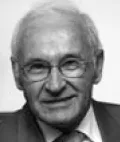
Igor Ziernfeld (1 January 1934 – 1 November 2023)
It is with great sadness that we announce that, in his 90th year, our esteemed colleague and honorary member of the Slovenski oktet, the tenor Igor Ziernfeld, has left us.
On behalf of the generations of the Slovenski oktet, we thank our esteemed friend and fellow singer for his devoted and loyal friendship within the ranks of this ensemble, and we extend our heartfelt condolences to his family.
May he rest in peace.
Slovenski oktet
Ljubljana, 2 November 2023
Excerpt from the book by B. Pangerc: Slovenski oktet, Ljubljana, 2007
Igor Ziernfeld was born in Ljubljana on 1 January 1934 and now lives in Rodica near Domžale. He sang first tenor in the Slovenski oktet from 1978 to 1996. He received a technical education and, after completing secondary school, became head of technical services. He was employed longest at Maksimarket, as head of maintenance.
His love of singing awoke in his earliest years: he sang in the children’s Franciscan choir in Ljubljana, then from 1952 in the “Tone Tomšič” Academic Choir, in 1955 in the Slovenian Philharmonic choir, then in the Radio Chamber Choir, and from 1978 to 1996 in the Slovenski oktet.
Igor Ziernfeld trained his voice with Prof. Jasna Špiler, with whom he studied solo singing for six years; it was Danilo Čadež who brought him to the octet.
His singing reached its peak with his membership of the Slovenski oktet; like all its other members, he sang with soul and heart, and it was precisely this extraordinary joy in music that was the healthiest foundation for artistic growth. At rehearsals, and especially on stage, he always tried to give his all. Ziernfeld very much enjoyed singing the Orthodox liturgy, as he was drawn to its grandeur. Arrangements of folk songs also suited him well. Modern choral literature, especially that written after 1970, was not closest to his heart, although he devoted himself to these pieces too with complete seriousness and attention, since the Slovenski oktet, as a leading performer, also had to turn to contemporary composers.
What he liked about the Slovenski oktet was its approach to work and to performing. The octet always gave its best on stage, always singing with maximum commitment and responsibility. They never cancelled concerts, not even because of illness. If one of the singers lost his voice, he would rather stand on stage as a silent extra than be absent.
In almost two decades of singing with the Slovenski oktet, Igor Ziernfeld accumulated so many memories and experiences that he can hardly keep up with them in his mind. During our conversation they fell like ripe pears, and we will quote them just as they came:
“Ah, once – when we were singing in Kraków, Poland – Igor told us – as I was walking on to the stage (the first piece was Ascendit Deus; Gallus) I was seized by a complete blackout. My memory suddenly left me! And since I start first, I was more frightened than I have rarely been. Only when Danilo gave the pitch did it open up again, and a weight was lifted from my heart …
Marjan Štefančič had a suitcase stolen at the airport in Oslo. We reported it to the police, who immediately went hunting, and in the middle of the city they found the suitcase and caught the thief. When we then went to the police station to collect the suitcase, we also saw the two rascals sitting contritely on a bench in the office, shaking their heads, unable to believe they had been caught so quickly after such a ‘careful’ theft.
I took away strong impressions from Angola, where all the concerts were cancelled because of the president’s death; but at the wish of Neto’s widow we sang beside the bier and at the funeral.
Our visit to Brazil was made possible by two businessmen from Gorenjska, the Hlebanja brothers, who had been exceptionally successful in São Paulo.
China is a world of its own. The entire political leadership attended the concert in Beijing. In place of Jože Banič, who was busy with the Slovenian Philharmonic orchestra, Stane Mancini stepped in for the tour. We both caught a cold just a few days before the concert, and our hosts took us to a Chinese doctor. Mancini had lost his voice completely.
The doctor gave me six kinds of tablets. But Mancini he jabbed with a needle straight into the vocal cords and gave him an injection. In the evening he sang. And how he sang! He warbled.
On the way back from China, because of the time difference, we experienced the New Year twice on the plane. And twice we celebrated, and twice we were served champagne.
We travelled around the USA in our own coach – and we had a driver who organised absolutely everything, from food to lodging. And in the evening, at the concerts, he even sold our cassettes!
Many Slovenes came to our concerts across the USA. In Montana a Slovene woman came to a concert from 800 km away and brought us a potica.
Or the kindness and honesty of the Nordic people. In Norway I lost a wallet containing a considerable sum of money, and unfortunately there was none of my documents in it, only a prescription from a local doctor. On the basis of the prescription the finder tracked me down and after two days returned the wallet with all its contents. Out of the same honest motives Tomaž Tozon got his camera back, and Marjan Štefančič – after a year – his shoes. Unbelievable! In any case, small settlements in Norway always keep everything open; they do not lock their homes at all.”
In his personal archive Igor Ziernfeld has more than 1,400 photographs of the Slovenski oktet’s tours around the world. From the 1989 tour of the USA he also has an extensive diary, which he wrote as he went along in the form of (unsent) letters, and which forms an important testimony to his impressions and experiences of that great promised land, densely populated in the East and in the West, where “in the middle you can go 400 km without seeing a single house”.
(Ljubljana, 6 December 2005)
Related news
You may also be interested in…
Concert in Borovnica
Farewell to the former president of KD Slovenski oktet
Anton Bebler, Slovenian political scientist, defence expert, professor, diplomat and politician, * 10 March 1937, Moscow, † 5…